
Parents are supportive, but still cautious about AI use in schools
By: Piers Lee, Founder & MD, Novema
In Novema’s annual international schools brand equity and market insights study, we asked 665 parents about their expectations regarding the use of AI in international schools.
First, we found that most parents (88%) are already using AI either at work (44%) and/or personally (65%) and are therefore familiar with the technology.
When it comes to AI’s application in international schools, parents show the strongest support for its use in planning school timetables and resources, and in optimising class sizes and student mix to improve the learning experience. In these areas, more than half of parents support at least some use of AI to assist schools.
Questions may arise about how AI would help “optimise student mix”, for example, what assumptions would it make? These assumptions depend on how the AI is trained and would be influenced by existing human biases about what constitutes an effective class structure.
There are greater reservations about the use of AI to mark tests and exams or to assess students’ overall performance and progress. For more structured and quantifiable exams (e.g., multiple-choice tests), machines can significantly speed up grading and analyse patterns of consistent errors across multiple assessments, helping schools target teaching to individual student’s specific weaknesses.
However, concerns arise when AI is used to assess a student’s “overall performance,” with nearly one in four parents objecting to this. There are two main issues. First, assessing overall performance requires a high degree of human judgment — evaluating effort, interpersonal skills, discipline, non-academic strengths, creativity, and other qualities (soft skills) that contribute to a child’s development and future contribution to society and the economy.
The second concern relates to storing data on individual students and the risk that such data could be hacked or stolen. Many parents are worried about how this information could be misused by bad actors in the future.
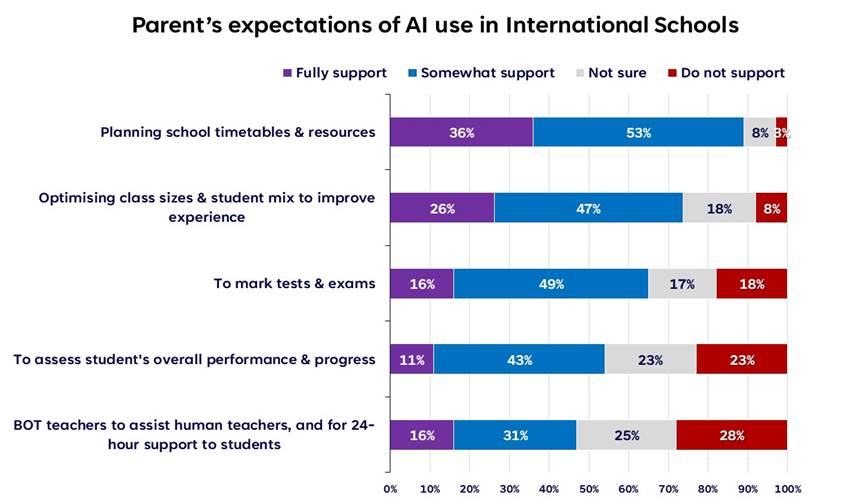
The strongest objections, however, relate to the use of bot teachers, even if these are intended only to assist human teachers. Fewer than half of parents support this idea, although about one in six “fully support” it, for example, because AI could provide 24-hour support for students. Concerns centre on the potential loss of human connection in teaching and the risk that AI could reinforce existing norms or biases, potentially disadvantaging students with different strengths that might emerge in greater importance in the future.
Notably, support for AI in international schools is higher among Asian expats in Singapore compared to Western expats. For example, 69% of Asian expats support the use of AI in marking tests (versus 57% of Western expats); 62% support its use in assessing overall performance (versus 46%); and 50% support the use of bot teachers (versus 40% of Western expats).
How AI should be taught to children
Nearly all parents want schools to teach children about AI, for some areas usually in both primary and secondary schooling years.

However, reflecting their own concerns about AI, parents tend to prioritise teaching about AI’s limits and biases over teaching the underlying theories (e.g., principles of LLMs, algorithms, or machine learning), how to use AI tools, or how AI might reshape future workplaces, including the potential redundancy of certain jobs.
Even at their child´s young age, parents expect schools to guide them on digital wellbeing, for example, understanding the impact of digital services on health; recognising inherent biases in AI; and learning about privacy, security, and the high energy consumption associated with AI use.
So, despite current discussions about a potential “AI bubble,” even if an AI crash were to occur, AI would continue to develop, much as e-commerce continued to grow after the dot-com crash of the early 2000s.
This means that all schools will need to integrate AI teaching within their curriculum and take on some level of AI integration within their operational management.
This article was first published in the Q4 2025 edition of Asia Research Media



How GenAI is transforming market research