The market research industry has been one of the fastest adopters of AI as applications and the benefits of AI are broad and easy to realize. Many specialist vendors have provided AI-powered solutions to their products, e.g. via automated surveys and insights.
Market research agencies are incorporating AI into their own solutions and being more creative in the application of AI to research, for example to design surveys and even to create stimulus. Like other industries, most organisations recognize the need to build a strategy on AI, for fear of being left behind by competitors.
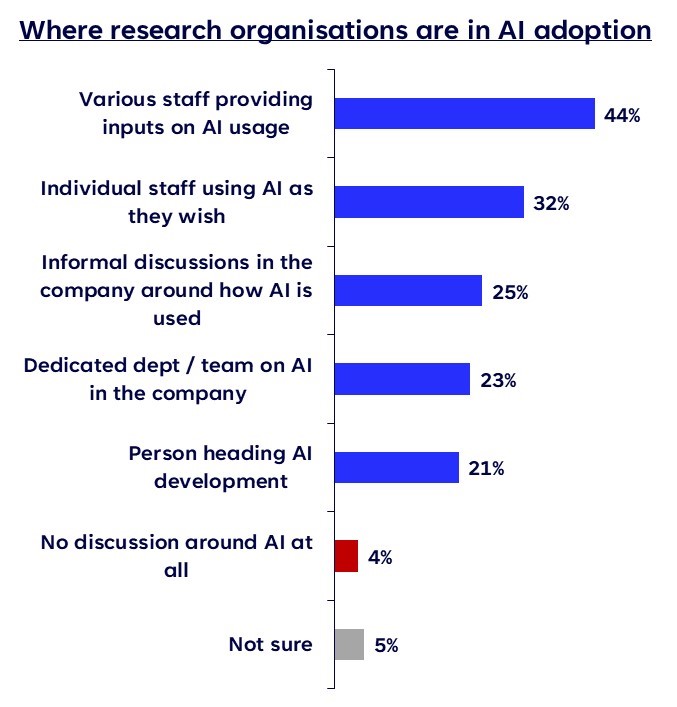
Based on the Asia Research survey, we discovered that only 9% of organisations had no discussion at all, or did not know their organization’s position on AI. While this figure would be higher at an industry level (those not involved in AI are unlikely to have started this survey), we can conclude that most organisations in this sector are engaged, to a degree, in AI.
38% of organisations have either a dedicated department or a person heading AI development, but more companies (47%) have an informal approach to using AI, e.g. individual staff using it as they wish, or staff just providing inputs with no department overseeing it, and no formal guidance. As a new technology with lack of transparency, some acknowledge that AI adoption will be a bit of ‘trial and error.’
AI adoption can be more challenging in regulated industries like financial services and healthcare. For some client organisations, if they are aware that a supplier is going to use AI in their research, they have to undergo an additional risk assessment. Often, the supplier would need to ‘declare’ their use of AI. Some firms are providing AI risk evaluation as part of their service to clients, including use of score cards!
Public sector clients can be more wary of AI than the private sector (requiring ´clear justification for AI use´), and younger brands can be more open to the new technology than more established brands.
While most of the AI development comes from internal research, most organisations also look externally by speaking to specialist AI vendors, looking at best practice in other industries, or attending seminars to learn about AI. Very few involve academia in their consultations suggesting either a disconnect with the technical side of AI, or lack of access to academic institutions.
44% of suppliers are consulting their clients/brands about their needs on AI development. Vendors can offer a AI Client Advisory Team that collaborates with brands to uncover needs, and a dedicated Product Value Team to showcase AI prototypes.
However, more suppliers are not choosing to consult clients/brands, suggesting that for many suppliers, they ‘would know best’ about what AI the clients should be using, and are just making the recommendations. The AI solutions can be the ‘new tools’ that the suppliers want to speak to clients about—a good client engagement opportunity, so these consultations can, in fact, just be ‘selling’ opportunities.
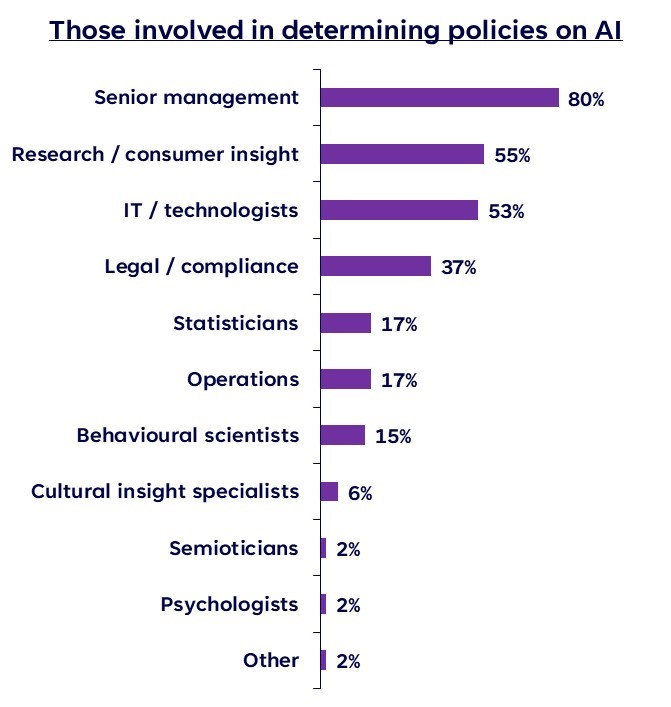
The importance of AI requires most organisations to involve senior management in determining policies towards its use. Other key influences are research/ consumer insight, IT/tech, and legal/compliance. 25% of organisations involve at least one type of specialist, often being statisticians, operations, or behavioural scientists. Multiple stakeholders can form steering committees on AI. Some report that the priorities for AI are more towards optimizing it for speed & efficiency, e.g. for fieldwork and data processing, rather than for greater insight or QC—hence it is more commercially-driven than academic-driven. Other efforts around AI are aimed at understanding human responses to stimuli, predicting behaviour and attitudes. Tech firms also look to AI to reduce human effort in surveys and improve compensation models for respondents. Despite the biases in AI that arise from cultural differences, very few use cultural insight specialists in determining their policies, indicating that this could emerge as a potential weakness in the wider adoption of AI.