Once a trend, sustainability is now a business imperative in the FMCG sector, influencing brand equity, purchase behaviour, and consumer trust. Consumers now expect brands to reduce their environmental impact, incorporate sustainable practices across operations, and communicate their progress transparently.
In this article, we consolidate key insights from our research across Australia and APAC, highlighting consumers’ sustainability priorities, the risks of unmet expectations, and best practices for sustainability-focused brand building.
The role of sustainability in brand equity
Consumers are no longer just asking brands to act; they’re expecting proof. Only 44% of global consumers trust brand sustainability claims, underscoring the need for transparent, consistent, and evidence-backed communication.
Successful brands embed sustainability across their supply chains and operations, not just in their marketing. Environmental, social and governance (ESG) performance is emerging as a crucial benchmark of trust for both consumers and regulators. Across APAC, governments are implementing stricter disclosure requirements, which align with consumer sentiment – 49% stated that ESG performance influences their willingness to recommend a brand.
To accommodate for these expectations, we recommend:
- Use specific and credible sustainability terms like ‘carbon neutral’ or ‘carbon reduction’ instead of vague language like ‘eco-friendly’, which is more often associated with greenwashing.
- Share evidence and impact metrics, ideally linked to international standards and verified partners.
- Make sustainability visible through packaging, labelling, and storytelling across channels – particularly on social media, where 88% of climate-related consumer conversations take place.
The cost-of-living crisis & consumer trade-offs
While consumers expect more from brands, they also face their own limits: price sensitivity, information fatigue, and distrust of vague claims, especially amid the cost-of-living crisis. However, sustainability remains influential, with 73% saying they would change their consumption habits to reduce environmental impact.
More than half of the respondents said they would stop (or reduce) buying from their favourite brand if they found out it was not environmentally responsible.
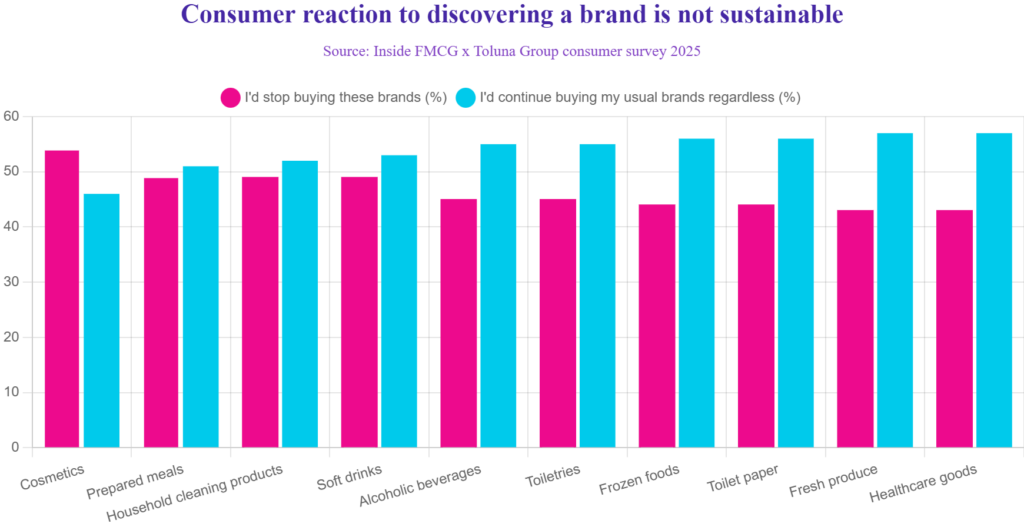
That said, tension lies between values and affordability. Cost perception still deters some consumers from choosing sustainable options. While consumers do claim they’re willing to pay more for sustainability, most cap that willingness at around 10% extra.
To navigate this, brands need to focus on:
- Closing the value–action gap by making sustainable choices easier through transparent labelling, default sustainable options, loyalty incentives, or visual cues reinforcing ethical impact.
- Reinforcing that individual actions matter through empowering messaging and visible proof of collective impact.
- Highlighting brand-led solutions such as reducing production emissions and improving supply chains.
Challenges & opportunities for brands
In high-cost environments, consumers still care deeply about sustainability, but they need support to act on those values. They expect brands to lead the way, which can be challenging as brands face operational barriers like:
- Increased production costs associated with sustainable materials and ethical sourcing.
- Supply-chain complexities that hinder verification.
- Insufficient tools to track and report progress credibly.
Apart from these barriers, brands also face reputational risks, with 62% of consumers worldwide expressing distrust towards brands’ sustainability messaging. Generic claims don’t cut it. Consumers want to see third-party certifications, clear & data-backed impact statements, and honest communication about progress (as well as limitations).
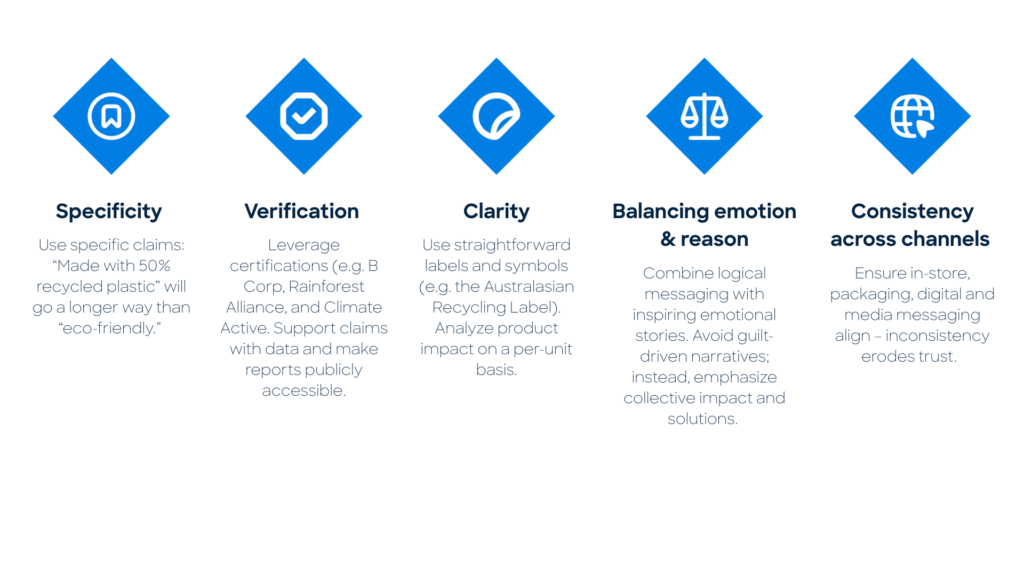
When it comes to messaging, the smallest details can influence consumer trust. Based on our data, the most effective messaging strategies hinge on:
When asked how they research a brand’s sustainability credentials before purchasing, most consumers cited packaging as one of the main touchpoints, with 72% depending on packaging labels to comprehend a brand’s sustainability commitment.
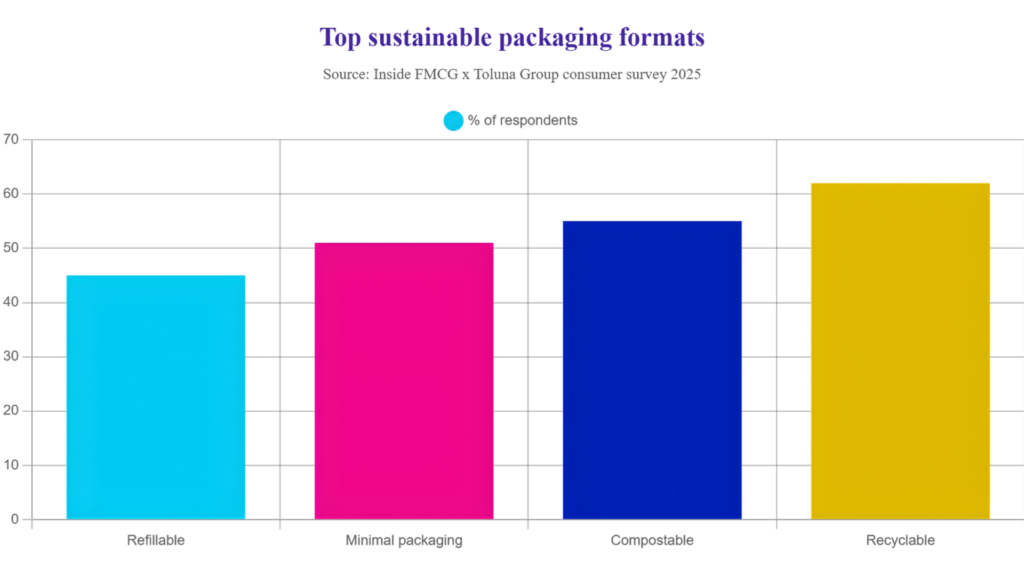
When asked to select the most important sustainability-related aspects of packaging, consumers prioritized recyclable packaging, compostable materials, and minimal packaging volume.
Successful sustainable packaging gets it right by:
- Maintaining functional integrity while switching to better materials.
- Clearly labelling packaging recyclability and sustainability effects
- Educating consumers that packaging can be both practical and eco-friendly, to counter skepticism.
Data, traceability, and AI: the future of FMCG
In an increasingly demanding landscape, data is essential for brands to understand sentiment, adapt strategies, and bridge the sustainability perception gap. Traceability is also becoming an effective tool for building trust, as the desire for transparency remains strong.
Moreover, AI is reshaping how brands forecast, innovate, and communicate their sustainability efforts. It brings scale, speed, and precision to strategy development and execution. Smart labelling systems, digital product passports, and government initiatives across APAC are forming the backbone of next-generation sustainability strategies.
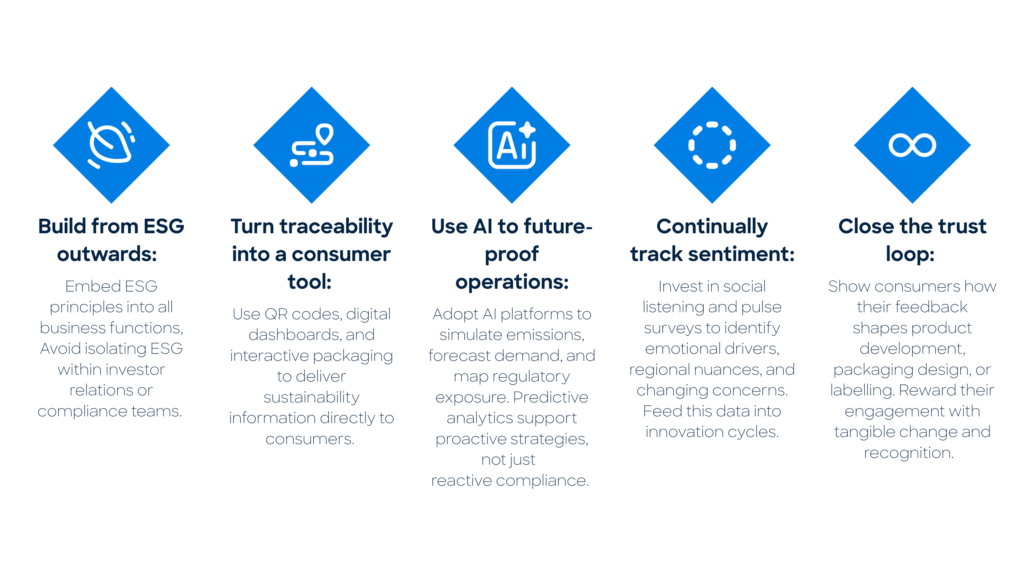
To stay ahead of these changes, brands should consider implementing:
The future of sustainable FMCG brand building relies on closing the loop between intention, action and perception. By embedding transparency, leveraging technology, and elevating consumer trust, brands can transform sustainability from a compliance burden into a competitive advantage.