By Piers Lee, Director, BVA BDRC Asia

Research on expats is often reserved for highly specialized projects, such as international banking, international schooling, relocation services, etc. However, we argue that this is a market that warrants far more attention.
There are an estimated 60 million expats globally, with this number increasing each year as more countries recognize the benefits of attracting expats. Some nations now offer a wider range of visas, making relocation easier. Additionally, high taxes, rising crime rates, and declining living standards in home countries are prompting more people to consider ´expat-friendly´ destinations.
The top source countries for expats include the USA, Canada, the UK, France, Germany, India, and the Philippines—many of which are English-speaking nations and home to numerous multinational corporations who often relocate personnel overseas.
Often, brands exclude expats from their ´nationally representative surveys´. The reasons are not always clear, though some clients perceive expats as having limited lifetime value, assuming they won’t stay long in the market, or are difficult to reach. While the latter may be true from both a marketing and research perspective, expats are often omitted simply because they are underrepresented in online panels and can be costly to research.
Brands may underestimate the lifetime value of expats. The ´roving expat´ — those who stay in a market for just a few years before moving on—is now quite a rare demographic. According to BVA BDRC’s research, these ´roving expats´ (defined as those in a country for less than three years and planning to relocate within the next three) make up only 3% of expat families in Singapore, 3% in Thailand, and 5% in Malaysia.
In Southeast Asia, BVA BDRC conducts annual surveys among expats to assess the brand equity of leading international schools—services primarily targeted at expat families. The source markets for expats in Singapore are predominantly English-speaking nations and major European economies.
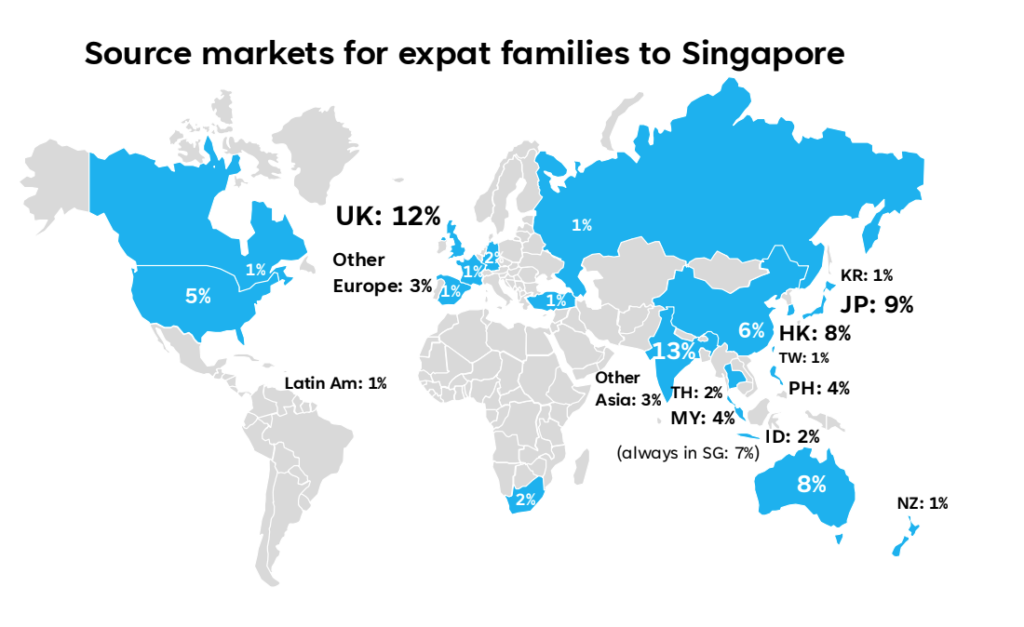
We also observe expats arriving from neighbouring Southeast Asian countries, Japan, and Australia/New Zealand (ANZ), partly due to regional proximity, as expats often prefer to stay within the Asia-Pacific area. Additionally, foreign direct investment from large Asian economies like China, Japan, and Korea into Singapore contributes to this trend.
Where different expat groups choose to live in Singapore varies. The BVA BDRC survey of parents in 2024 showed that the top neighbourhoods for expats include Orchard/River Valley, Tanglin/Holland/Bukit Timah, Hougang/Punggol/Sengkang, East Coast/Marine Parade, Ang Mo Kio/Bishan/Thomson, and my own neighbourhood of Newton/Novena. Americans and Japanese are more concentrated in Orchard/River Valley, British and Australians in Tanglin/Holland/Bukit Timah, Indians in Hougang/Punggol/Sengkang, Europeans in Buona Vista/West Coast/Clementi, and Chinese nationals in Newton/Novena.
Also important to note is that 7% of expats in our survey state that they have ‘always been in Singapore’. This represented a second generation of expats who have been born in Singapore and choose to stay and bring up their own families in the country.
There are substantial opportunities for brands to market to the expat sector. Expats generally have higher disposable income than local populations, and distinct needs and preferences for investment products, international travel, and leisure activities. These areas require far more insight than brands currently possess.
BVA BDRC specializes in expat research, including maintaining panels of expats, and can provide the insights needed to effectively gauge and engage this important market.
This article was first published in the Q4 2024 edition of Asia Research Media