By, Novema Pte Ltd
May 2026
When Asia Research Media conducted its AI impact survey in 2024, 37% of industry stakeholders were unsure how AI would change the market research industry.
Since then, more organisations have formalised their approach to AI adoption, AI usage has increased significantly, and most suppliers have now identified the business models they intend to pursue through the integration of AI into their product offerings.
The current evolution of AI demonstrates growing sophistication in how it is being applied. Initially, agencies adopted AI primarily through Large Language Models (LLMs) for text analysis and automated insight generation. As a result, the greatest adoption of AI has been in desk research, for example, scanning findings across multiple sources and automatically generating insights from large volumes of unstructured data. This has driven increased use of AI in qualitative research, and the Asia Research survey shows that qualitative researchers are using a wider range of AI applications than their quantitative counterparts.
Using chatbot moderators was still relatively uncommon in 2024, with only 14% of organisations using them. However, over the past two years, this has become far more mainstream, with 39% of organisations now using AI moderators. As AI becomes increasingly embedded within qualitative research departments, most organisations are using it for brainstorming (65%) and research design tasks such as developing discussion guides (63%).
The AI applications expected to experience the strongest future growth are more quantitative in nature. The next stage of AI adoption is therefore likely to involve greater use of historical data, predictive modelling, and forecasting. AI-driven quality checks on surveys are expected to see the highest future growth, although adoption has been slower than suppliers initially anticipated, suggesting that operational challenges or even resistance still remain in this area.
Qualitative feedback from the 2026 survey indicates that AI applications could fundamentally reshape research workflows. Traditional two- to three-month project cycles may disappear as linear processes are replaced by integrated, agent-driven systems capable of automated questionnaire design, AI-moderated interviews, instant analysis and reporting, and interactive deliverables. This shift could ultimately lead to continuous, always-on research embedded directly into organisational decision-making.
As a result, the human role within research will need to evolve from “insight generation” to “decision intelligence”. There will be less emphasis on traditional questions such as: What happened? Instead, the focus will move towards: What will happen next? and What should we do about it? Agencies will need to evolve from being data providers into strategic advisors, insight translators, and decision-making partners.
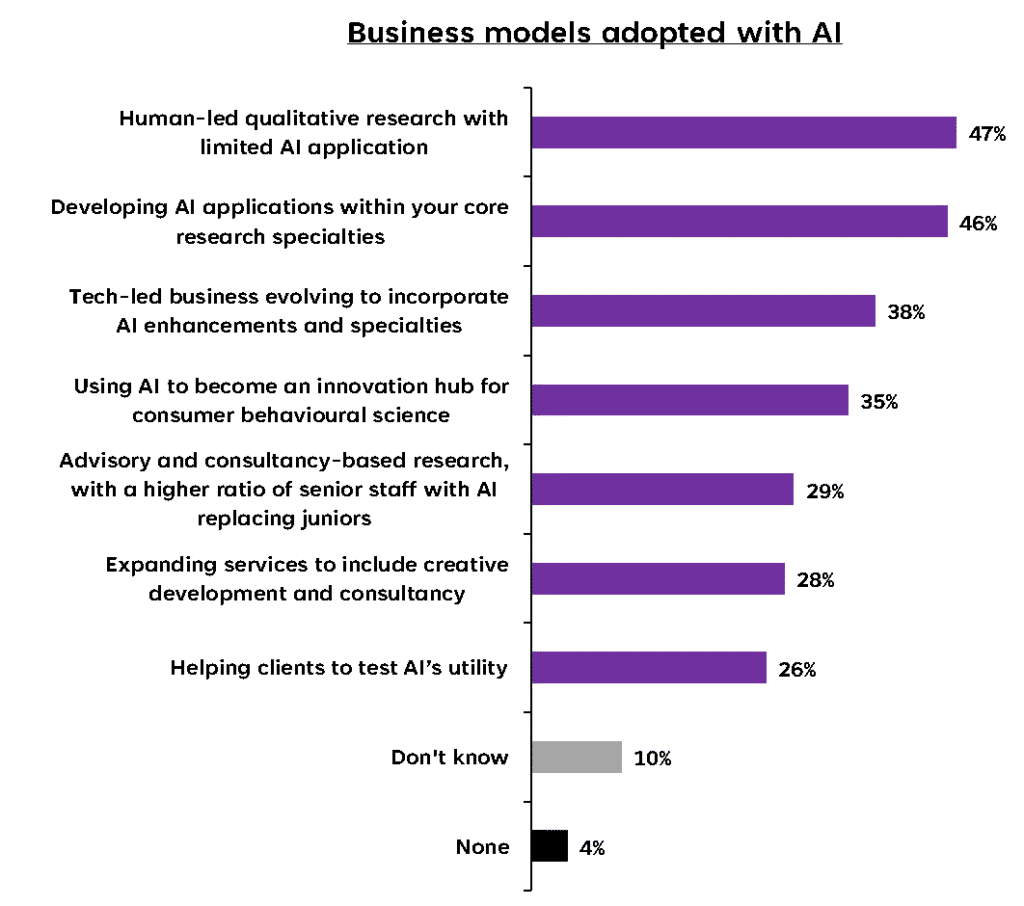
At the same time, almost half of suppliers say they intend to “fight back” against so-called “AI slop” by emphasising human-led qualitative research with only limited AI integration. These agencies are likely to position themselves around contextual understanding, cultural interpretation, deep market expertise, and specialised knowledge of clients’ industries, products, and markets. They may also focus on multi-method approaches that remain less easily replicated by AI, such as ethnography, shop-alongs, and observational research.
However, many of these agencies are simultaneously exploring multiple and sometimes contradictory business models perhaps as a hedge against uncertainty. Ultimately, they are waiting to see which approaches succeed as the AI-enabled market evolves, particularly given the unknown implications of future generations of “super AI”.
The agency landscape is therefore likely to split into three broad models:
1. Technology providers offering fast, low-cost, self-serve AI solutions, often with some degree of vertical specialisation
2. Lean agencies using AI to automate project management and analytical “grunt work”, while senior talent focuses on strategic interpretation and advisory value
3. “Human-led” research firms selling depth, context, and expertise, while still using AI behind the scenes albeit often downplaying the extent of its use
Much like the growth of online consumer panels in the 2010s and the rise of self-serve research platforms, AI is likely to accelerate the insourcing of research within client organisations. As a result, the proportion of research outsourced to agencies will decline.
Large agencies face additional pressure from heavy infrastructure, rising overheads, large administrative functions, and increasingly burdensome internal processes. At the same time, clients are applying pricing pressure that makes these cost structures difficult to sustain. Just as online panels democratised data collection, smaller AI-enabled players can now scale more efficiently. As clients increasingly seek lower-cost options, large agencies may ultimately retain only the biggest multinational accounts that still require extensive in-market servicing.
In the meantime, the industry is likely to experience further consolidation, with some agencies disappearing altogether. Generalist agencies may survive for a limited period by competing for public-sector work and other areas that remain less outsourced or less automated.
The agencies that survive in the long term will need to be genuinely differentiated. Success will depend on proprietary methods, access to hard-to-reach audiences, and highly experienced researchers capable of delivering meaningful human value. That value will increasingly lie in the ability to frame problems more effectively, interpret outputs in unique ways, connect insights to business decisions, and communicate findings through compelling storytelling and influence.