By, Novema Pte Ltd
May 2026
Asia Research has undertaken extensive research into how AI is transforming the market research industry. A qualitative and quantitative study conducted in 2024 concluded that suppliers could adopt one or more of seven distinct business models through the integration of AI into their product offerings.
In a new study conducted in 2026, we found that the industry is likely to split into two broad value propositions. Approximately half of suppliers (47%) are expected to pursue a “human-led qualitative research with limited AI application” model, while the remainder will adopt varying levels of AI integration or specialisation.
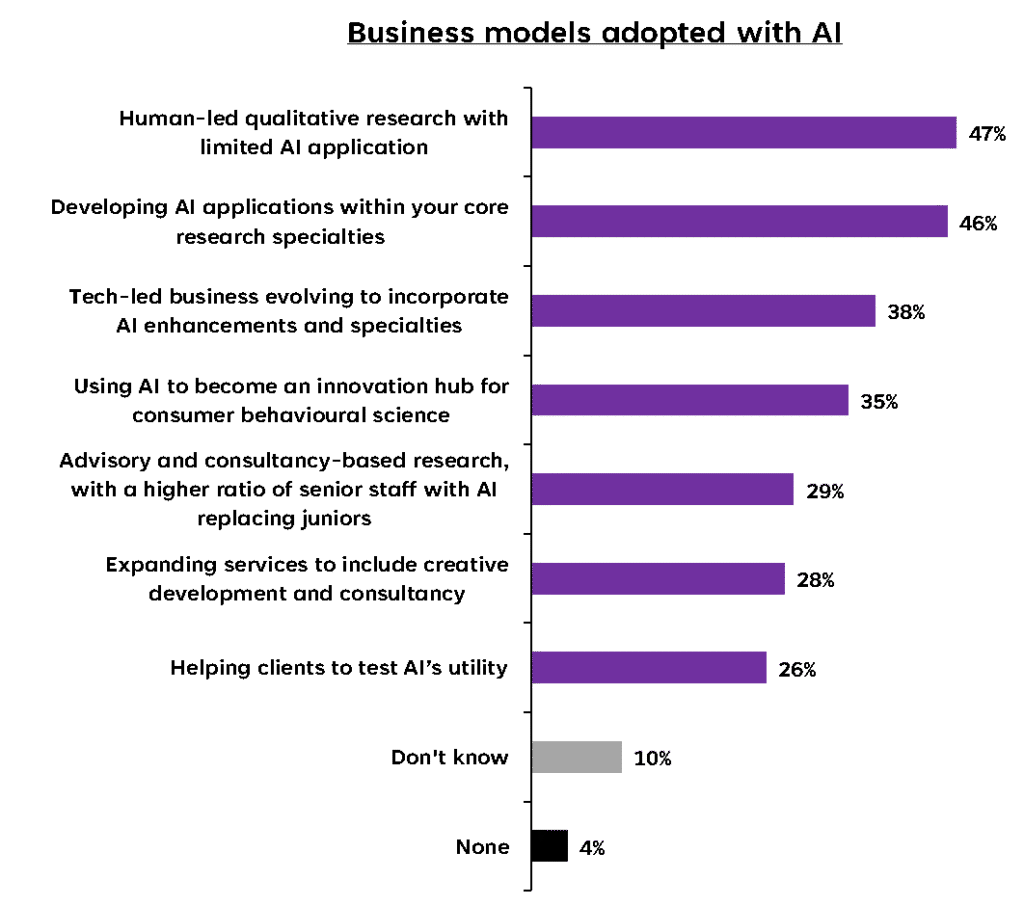
Paradoxically, quantitative researchers are just as likely to adopt “human-led qualitative” business models with claimed limited AI use. Paradoxically, organisations intending to follow this approach are, in many respects, more advanced in their use of AI. For example, they are more likely to employ dedicated staff for AI development and implementation and to apply AI across a wider range of research applications. Those adopting a “human-led” positioning are also more likely to combine it with additional business models. This includes offering advisory and consultancy-based research services, maintaining a higher ratio of senior staff as AI replaces more junior roles, and helping clients test AI’s utility.
The leading AI-enabled business model, expected to be adopted by 46% of stakeholders, involves using AI applications developed specifically for agencies’ core research specialities, such as advertising, media, shopper insights, and competitor intelligence.
A sizeable segment of the market (35%) may use AI to position itself as an innovation hub for consumer behavioural science, while 28% may expand into creative development and consultancy by blending traditional research with AI-generated creative and strategic services.
Clearly, a technology-focused segment within the consumer insights industry is emerging through AI adoption. Around 38% of organisations expect to incorporate AI enhancements and specialised capabilities, including the provision of more self-service AI tools. While this has traditionally been the domain of AI and research technology suppliers, which represent 10% of organisations surveyed, mainstream agencies are also likely to market these capabilities, probably through specialist divisions within a broader suite of research services.
As most researchers have already identified both the errors and limitations of AI, there is also a significant market opportunity (26%) for suppliers that help clients stay informed about AI developments in the research landscape and maintain compliance with corporate guidelines.
These business models translate into two primary marketing approaches for suppliers. The main distinction is between those positioning themselves as “human-centric” emphasising that AI serves only as a support tool for researchers, with humans remaining responsible for regulating AI use throughout the project cycle and ensuring the reliability of outputs, and those marketing the strength of their AI models.
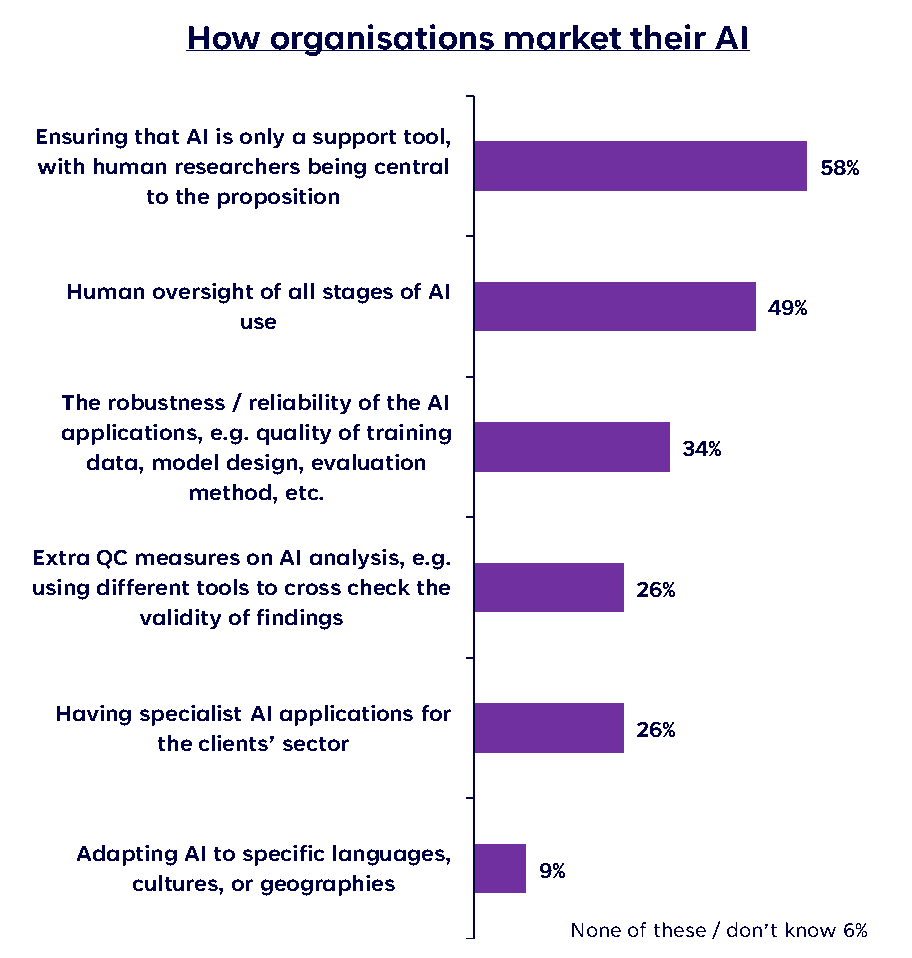
The latter group will differentiate themselves through the robustness and reliability of their AI applications, including the quality of training data, model design, and evaluation methods (34%); additional quality-control measures for AI analysis, such as using multiple tools to validate findings (26%); specialist AI applications tailored to clients’ sectors (26%); and the adaptation of AI to specific languages, cultures, or geographies (9%).
Currently, 9% of suppliers report that they “do not know” which business model they expect to adopt in the future. More notably, 28% of clients are uncertain about the type of suppliers they intend to use going forward. This suggests that the client base on which vendors depend is even more uncertain about which AI-enabled suppliers they will ultimately choose to work with.
The industry may still require several more years to stabilise, given that AI remains a relatively new technology. The key question is whether the next generation of Artificial Superintelligence (ASI) will fundamentally reshape the landscape once again.