By James Redden, CEO APAC & US, and Annie Low, Associate Director, 2CV
If you’ve embraced AI and simultaneously felt overwhelmed about its actual and potential role in the workplace, you’re not alone.
We asked 500 senior marketers across APAC (Australia, China, India, Malaysia, Philippines, and Singapore) how they felt about AI. And their mixed responses reveal interesting tensions about how we are navigating AI growth pains as its role continues to evolve in the workplace.
Marketers are increasingly experimenting with AI
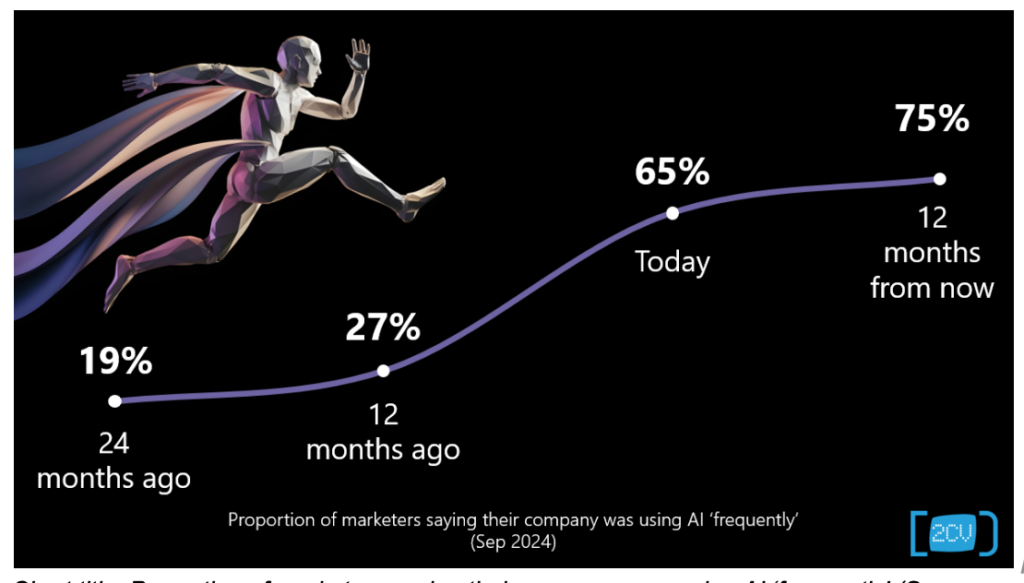
There has been a massive leap in use in the last 12 months, especially considering that ChatGPT was released only 24 months ago (November 2022). Adoption is expected to grow in the coming 12 months.
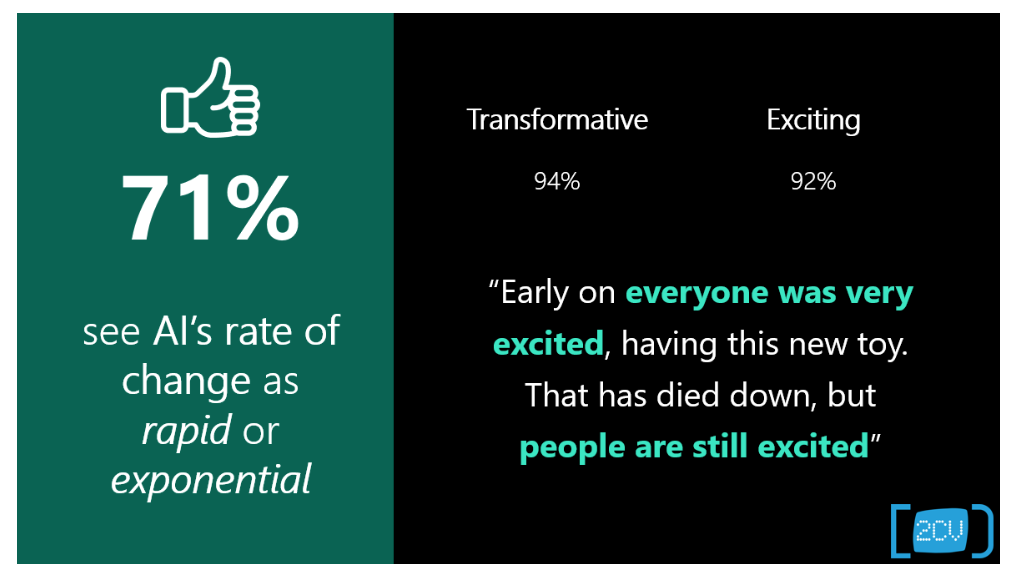
Marketers said their top four reasons for using AI were for: competitive analysis; social media management; producing content; and personalization of messaging. Most see AI technology moving rapidly, generating excitement among marketers, which almost everyone agrees is transformative for the marketing industry.
There is some feeling that the hype may be dying down, as seen in this highlighted quote from a marketer in the video games industry. But this is the exception—on the whole, people feel AI is innovative, efficient, and transformative.
Uncertainty and pressure around AI adoption
Despite the positivity, the high rate of change has left many feeling overwhelmed (72%).
This is due to uncertainty about what AI could mean for marketing in the future and is compounded by the pressure of having to learn a new set of tools just to keep up.
One of the APAC marketing leads we interviewed asked if we thought they were ahead or behind in AI adoption, based on the various interviews we had done—highlighting the uncertainty about whether companies are keeping up or not.
A sizeable number of marketers (42%) see AI in marketing as ´risky´. This is due to reasons such as customer/data privacy issues, and brand reputation risks. Reputational risks extend beyond data security and include a concern that AI-generated images or text can make a company appear less authentic.
What also came up as a real fear was job losses. While some marketers felt they were safe as they used skills that AI could not replace—for example, people management, intuition or creativity – many worried that AI would become so good that they could conceivably be replaced.
And one in five marketers also see the use of AI as unethical—this moral stance came in a few different guises, including biases, copyright, privacy and sustainability.
What does AI mean for human creativity?
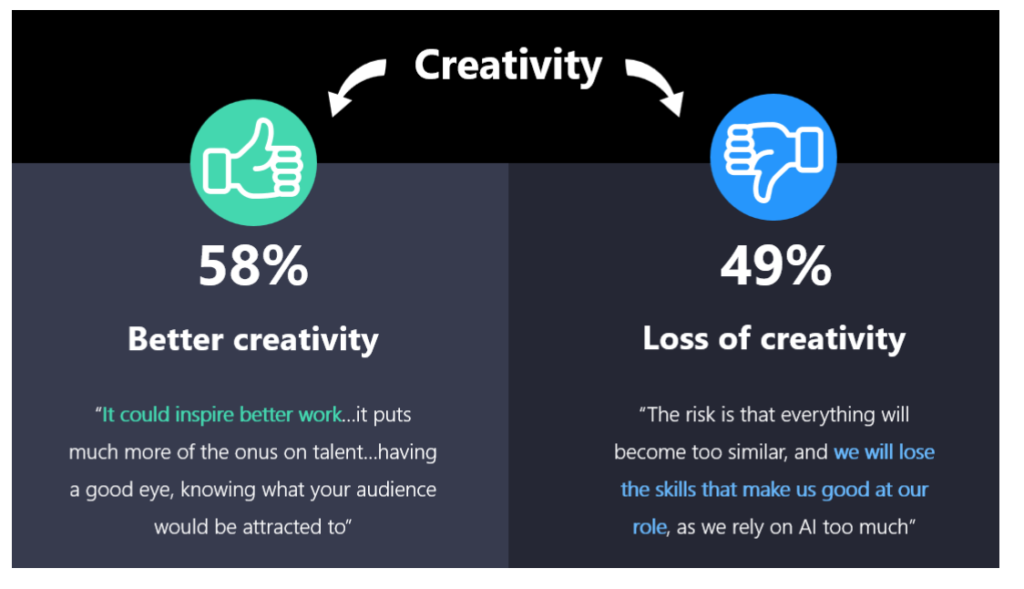
One of the most interesting findings was around how AI will affect creativity—there were both positive and negative expectations, again highlighting the uncertainty amongst marketers.
On the positive side, many talk about speeding up the creative process—for example, in generating some initial copy or imagery to start off the writing process, or allowing for a larger number of iterations for creatives. There is also the feeling that AI could sharpen what makes marketers great—less about managing processes and more about understanding customers.
On the negative side, several marketers talk about the potential downside of relying on AI too much—resulting in potentially bland and repetitive ´creative´output, and a loss of creative skills among marketers.
We face similar complexities in the research workplace
AI tools have already done a great deal for research productivity—for example, AI-assisted transcriptions and thematic analysis are rapidly becoming go-to tools for qualitative research.
Auto-transcription software was often useless in APAC two years ago as it struggled to recognise English spoken with Asian accents. Now, some tools can transcribe that same audio—even adding punctuation and capitalising proper nouns—with the option to pre-select a speaker’s accent for greater accuracy. Further advances have been made into real-time audio translation and content summaries.
However, AI-powered tools are not a silver bullet. There are still notable imperfections and significant risks to using them. In October, Whisper, an OpenAI-powered notetaker (the company behind ChatGPT), was found to hallucinate entire sections in the transcripts it produced. This posed real risks as it had been widely adopted across industries—but it was particularly dangerous in hospitals, where it had invented medical treatments. A surprise to engineers and researchers, this AI was not used for generative purposes yet these problems ´persist even in well-recorded, short audio samples´.
AI can also make it easier for respondents to conduct fraud—for example, we have noticed respondents attempting to use AI-generated text. While we can still catch these instances simply by reading the text, the way forward looks to be an uphill battle. AI ´fraud detection´ software is notoriously unreliable, often giving false positives (or negatives) as large language models (LLMs) continually evolve and emulate specific writing idiosyncrasies.
Will AI be the Butler, Partner or Cyborg?
Finally, we asked marketers what role they see AI playing in their marketing roles in the future.

These terms describe a continuum of how AI can support marketers, derived from work we have done with AI companies.
- As The Butler, AI does routine tasks to free me up.
- As The Partner, AI works with me, bringing complementary skills and improving my work, but the human is still in charge.
- As The Cyborg, AI is deeply integrated into my role, and we are inseparable in getting work done.
The marketers we surveyed were evenly split between predictions. This reflects the varying roles marketers hold; some will be more heavily affected by AI than others. But it also reflects the varying expectations of AI’s future potential. Some people can’t foresee it having more than a relatively minor role in the future.
As AI tools continue to develop, one growing area of focus and concern is the amount of autonomy we give to AI in the workplace, and how much control we need over AI-assisted processes.
Researchers, at the very least, will have their hands full as they continue building rigorous quality checks and processes—something marketers will also have to develop, as they reported that few companies currently have formal policies or planned initiatives around AI.
AI is changing very quickly. This brings huge uncertainty in the marketing industry, and it’s clear the industry will have to keep experimenting and evaluating AI as we move forward.
This article was first published in the Q4 2024 edition of Asia Research Media